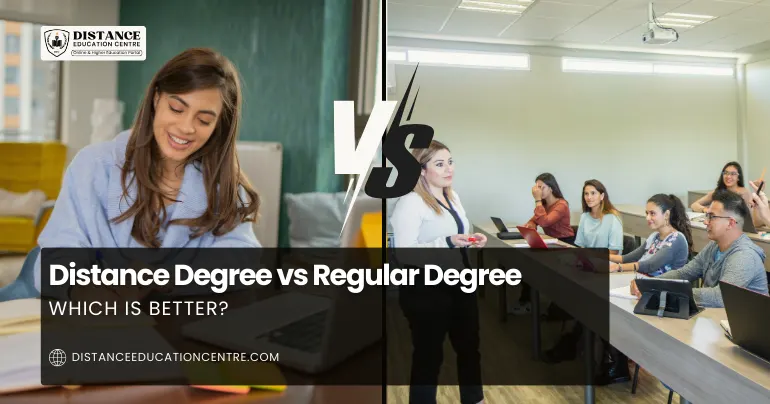
Choosing between a Distance Degree vs Regular Degree is one of the most important academic decisions students face today. With changing education systems, technological growth, and evolving employer expectations, traditional learning is no longer the only path to success. Distance education has emerged as a strong alternative, especially for learners who need flexibility, affordability, and accessibility.
Many students are confused about the difference between distance and regular education and often wonder which is better distance or regular degree for jobs, higher studies, and long-term career growth. The truth is, both options are valid and useful—but they serve different types of learners.This blog offers a detailed, unbiased comparison to help you understand the advantages, limitations, recognition, cost, placements, and career impact of both distance and regular degrees so you can make an informed decision.
Distance Degree vs Regular Degree: Quick Comparison Table
| Criteria | Distance Degree | Regular Degree |
| Mode of Learning | Remote / Self-paced | On-campus, full-time |
| Attendance | Not mandatory | Mandatory |
| Flexibility | Very High | Low to Moderate |
| Cost | Low | High |
| Admission Cycles | Multiple | Once a year |
| Campus Life | Not available | Available |
| Placement Support | Limited | Strong |
| Ideal For | Working professionals | Full-time students |
What Is a Distance Degree?
A distance degree allows students to pursue higher education without attending daily physical classes. Learning is delivered through a mix of:
- Printed study material
- Online PDFs and recorded video lectures
- Assignments, internal assessments, and term-end exams
Distance education is designed for learners who cannot commit to full-time classroom study. It is especially beneficial for:
- Working professionals
- Government job aspirants
- Students from rural or remote areas
- Learners with financial or personal constraints
When obtained from UGC-recognized universities, distance degrees are fully valid for employment and higher education in India.
What Is a Regular Degree?
A regular degree follows the traditional classroom-based education system. Students attend a college or university campus and participate in:
- Daily lectures
- Practical sessions, labs, and workshops
- Seminars, internships, and campus activities
Regular degrees offer a structured learning environment and are best suited for:
- Fresh school pass-outs
- Students seeking campus exposure and peer interaction
- Careers requiring hands-on training and practical learning
Difference Between Distance and Regular Education
Understanding the difference between distance and regular education is essential before choosing a degree mode.
| Aspect | Distance Education | Regular Education |
| Learning Style | Self-paced | Structured |
| Faculty Interaction | Limited | High |
| Peer Interaction | Low | High |
| Discipline Required | Very High | Moderate |
| Practical Exposure | Limited | Strong |
| Campus Activities | Not available | Available |
Distance education emphasizes independent learning, while regular education focuses on guided classroom instruction.
Admission Process & Flexibility
Distance Degree Admission
Distance education admission offers significantly greater flexibility:
- Multiple admission cycles (January and July in many universities)
- Mostly open or merit-based admission
- Online application process
- Easy re-registration and extended completion periods
This flexibility is ideal for learners who may miss a single admission window or need time to balance education with work.
Regular Degree Admission
Regular degree admissions are more rigid:
- One admission cycle per year
- Merit-based or entrance exam-based
- Limited seats and high competition
- Fixed academic calendar
Missing a regular admission window usually means waiting an entire year.
Fee Structure & Affordability
Cost plays a major role in the Distance Degree vs Regular Degree decision.
| Aspect | Distance Degree | Regular Degree |
| Tuition Fees | Low | High |
| Additional Costs | Minimal | Hostel, transport, daily expenses |
| Overall Affordability | ⭐⭐⭐⭐⭐ | ⭐⭐⭐ |
Distance degrees are often government-subsidized, making them accessible to students from all economic backgrounds. Regular degrees, while offering campus facilities, come with higher overall expenses.
Distance Degree Advantages and Disadvantages
Advantages of Distance Degree
- High flexibility
- Affordable fees
- Learn while working
- Suitable for career upgrades and promotions
Disadvantages of Distance Degree
- Limited campus placement support
- Requires strong self-discipline
- Less interaction with peers and faculty
Understanding these distance degree advantages and disadvantages helps students set realistic expectations and plan accordingly.
Learning Experience & Skill Development
Distance education demands self-motivation and time management. Students must take responsibility for completing coursework independently. This builds discipline but may feel challenging for some learners.
Regular education, on the other hand, provides:
- Daily academic guidance
- Immediate doubt resolution
- Strong peer learning environment
Both systems can develop skills effectively, but the learning style differs significantly.
Examination & Evaluation System
Both degree types typically include:
- Assignments and internal assessments
- End-semester or annual examinations
- Project work (course-specific)
Distance degrees usually allow more flexible exam attempts, while regular degrees follow a strict academic schedule.
Are Distance Degrees Valid for Jobs in India?
Yes. Distance degrees are valid for jobs in India if they are obtained from UGC-recognized universities.
Distance degrees are accepted for:
- Government jobs
- Competitive exams
- Higher education
- Promotions and career advancement
However, for roles that depend heavily on campus recruitment or practical training, regular degrees may offer an advantage.
Placement Support & Career Opportunities
| Factor | Distance Degree | Regular Degree |
| Campus Placements | good | Strong |
| Internship Exposure | good | High |
| Career Growth | Skill-based | Campus + skill-based |
Distance degree holders often rely on skills, experience, and certifications rather than campus placements.
Which Is Better: Distance Degree or Regular Degree?
The answer to which is better distance or regular degree depends entirely on your personal situation.
Choose a Distance Degree if you:
- Are working or preparing for competitive exams
- Need flexibility and affordability
- Want to upgrade qualifications
Choose a Regular Degree if you:
- Are a full-time student
- Want campus life and networking
- Need strong practical exposure
Conclusion
There is no single winner in the Distance Degree vs Regular Degree debate. Distance education offers flexibility, affordability, and accessibility, making it ideal for working professionals and self-motivated learners. Regular education provides structured learning, campus exposure, and stronger placement opportunities, making it suitable for full-time students.The best choice is the one that aligns with your career goals, financial capacity, learning style, and long-term plans.
FAQs
1. Distance Degree vs Regular Degree: which is better?
It depends on your career goals and learning needs.
2. Are distance degrees valid for jobs in India?
Yes, if earned from UGC-recognized universities.
3. What is the main difference between distance and regular education?
Flexibility and learning mode.
4. Do distance degrees have placements?
Limited compared to regular degrees.5. Which option is cheaper?
Distance degrees.