Choosing the right degree option is a major decision for students today. With multiple learning modes available, many learners feel confused about the distance degree vs online degree debate and how these compare with traditional college education.
This blog explains the difference between distance and online degree, compares them with regular degrees, and helps you decide which option suits your career goals, budget, and lifestyle.
Understanding the Three Types of Degrees
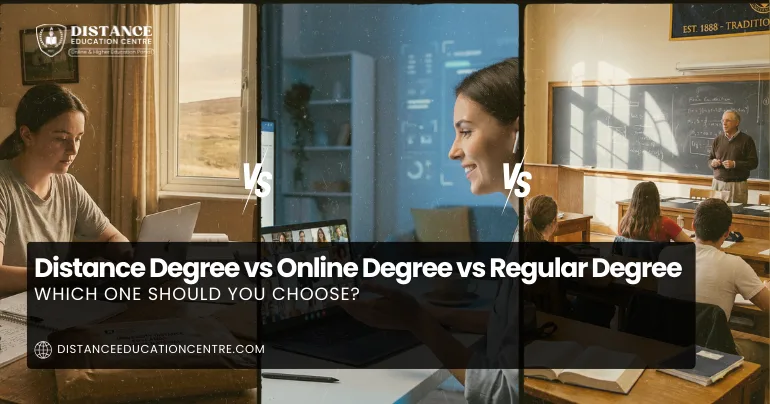
Students today can choose between distance, online, and regular degrees, each offering a different way of learning. A distance degree focuses on self-study and flexibility, an online degree provides structured learning through virtual classes, and a regular degree follows the traditional on-campus classroom system. Understanding these options helps you select the degree that best fits your goals, schedule, and learning style
What Is a Distance Degree?
A distance degree allows students to study remotely without attending daily classes. Learning materials are provided in printed or digital form, and students mostly rely on self-study.
- No daily classroom attendance
- Self-paced learning
- Exams conducted at designated centers
This option is widely chosen by working professionals and learners looking for flexibility.
What Is an Online Degree?
An online degree is fully internet-based. Classes, assignments, discussions, and exams are conducted through online platforms.
- Live or recorded video lectures
- Online interaction with faculty
- Structured academic calendar
When comparing distance learning vs online learning, online degrees offer more interaction and guided learning.
What Is a Regular Degree?
A regular degree follows the traditional on-campus education system.
- Fixed class schedules
- Face-to-face teaching
- Campus activities and peer interaction
This remains the most common choice for students straight out of school.
Differences at a Glance
| Feature | Distance Degree | Online Degree | Regular Degree |
| Mode of Learning | Self-study | Internet-based | Classroom-based |
| Flexibility | High | Very High | Low |
| Interaction | Limited | Moderate to High | High |
| Cost | Low | Medium | High |
| Campus Attendance | Rare | Rare | Rare |
Who Can Apply? (Eligibility Criteria Explained Simply)
Understanding eligibility is crucial when choosing between different degree modes.
Distance Degree – Eligibility Rules
- Passed Class 12 for undergraduate courses
- Graduation degree for postgraduate courses
- No age limit in most cases
These flexible rules make distance education accessible to many learners.
Online Degree – Eligibility Rules
- Class 12 pass for bachelor’s programs
- Graduation degree for master’s programs
- Access to a laptop/mobile and internet
Many students specifically search for distance degree eligibility criteria and online degree requirements before applying.
Regular Degree – Eligibility Rules
- Class 12 with required subjects
- Minimum percentage or cut-off marks
- Graduation for PG programs
Eligibility for regular degrees is usually stricter.
How Do You Get Admission? (Step-by-Step Process)
The admission process differs greatly between degree types.
Distance Degree – Admission Process
- Simple application form
- Document submission
- Fee payment
- Admission confirmation
No entrance exams in most cases.
Online Degree – Admission Process
Students searching for the online degree admission process should know that it is mostly digital.
- Online application
- Document upload
- Online test or interview (in some universities)
- Fee payment and class access
Regular Degree – Admission Process
- Entrance exams (if required)
- Merit list or cut-off
- Counseling and seat allotment
- Campus visit and document verification
This process is more competitive and time-consuming.
Recognition, Accreditation, and Validity
Before choosing any degree, it is essential to check its recognition, accreditation, and validity. These factors confirm whether a degree is officially approved and accepted for jobs, higher studies, and competitive exams. Regardless of whether the degree is distance, online, or regular, recognition from the appropriate authorities ensures that your qualification holds value and credibility in the job market.
A common concern among students is: is online degree valid for jobs?
The answer depends on recognition and accreditation.
If the degree is awarded by a recognized and approved institution, it is valid for:
- Private sector jobs
- Higher education
- Competitive exams (as per rules)
Always verify approval before enrolling.
Career Opportunities and Job Acceptance
When choosing a degree, it’s important to understand how it affects your job prospects. While employers increasingly value skills and experience, the mode of study can still matter in some roles. Knowing how distance, online, and regular degrees are accepted helps you make a smarter career decision.
- Distance Degrees: Accepted in many roles, especially for experienced professionals
- Online Degrees: Growing acceptance in IT, management, and digital fields
- Regular Degrees: Still preferred for campus placements and traditional roles
Employers now focus more on skills than learning mode.
Cost Comparison and Return on Investment
Cost plays a major role when choosing a degree. Comparing tuition fees, additional expenses, and long-term career benefits helps you understand the return on investment (ROI) of distance, online, and regular degrees and choose an option that fits both your budget and future goals.
- Distance degrees are the most affordable
- Online degrees offer good value without relocation costs
- Regular degrees are expensive but offer campus exposure
Choose based on both budget and long-term career plans.
Who Should Choose Which Degree?
Every student has different goals, schedules, and learning preferences. Understanding who each degree type is best suited for helps you choose the option that matches your lifestyle, career plans, and study needs.
Distance Degree if you:
- Are working full-time
- Need maximum flexibility
- Want affordable education
Online Degree if you:
- Want structured learning from home
- Are comfortable with technology
- Are upgrading skills
Regular Degree if you:
- Are a fresh school graduate
- Want campus life
- Aim for placements or research
Conclusion
When choosing between a distance degree vs online degree vs regular degree, there is no single right answer. The best choice depends on your goals, schedule, budget, and career plans. Understanding the difference between distance and online degree, knowing the online degree admission process, and checking validity will help you make a confident decision. With the right choice, any of these degree modes can lead to a successful career.
Read Also: UGC-Approved Distance Education Universities 2026
FAQs
- What is the difference between distance and online degree?
Distance degrees focus on self-study, while online degrees provide live or recorded classes with interaction. - Distance learning vs online learning – which is better?
Online learning is better for guided study, while distance learning is better for flexibility. - Is an online degree valid for jobs?
Yes, if the degree is from a recognized institution. - Which is better: online degree vs regular degree?
It depends on your career goals, learning style, and availability. - Who should choose a distance degree?
Working professionals and learners need flexibility. - Which degree option is future-proof?
Online degrees are rapidly growing and widely accepted.