Introduction
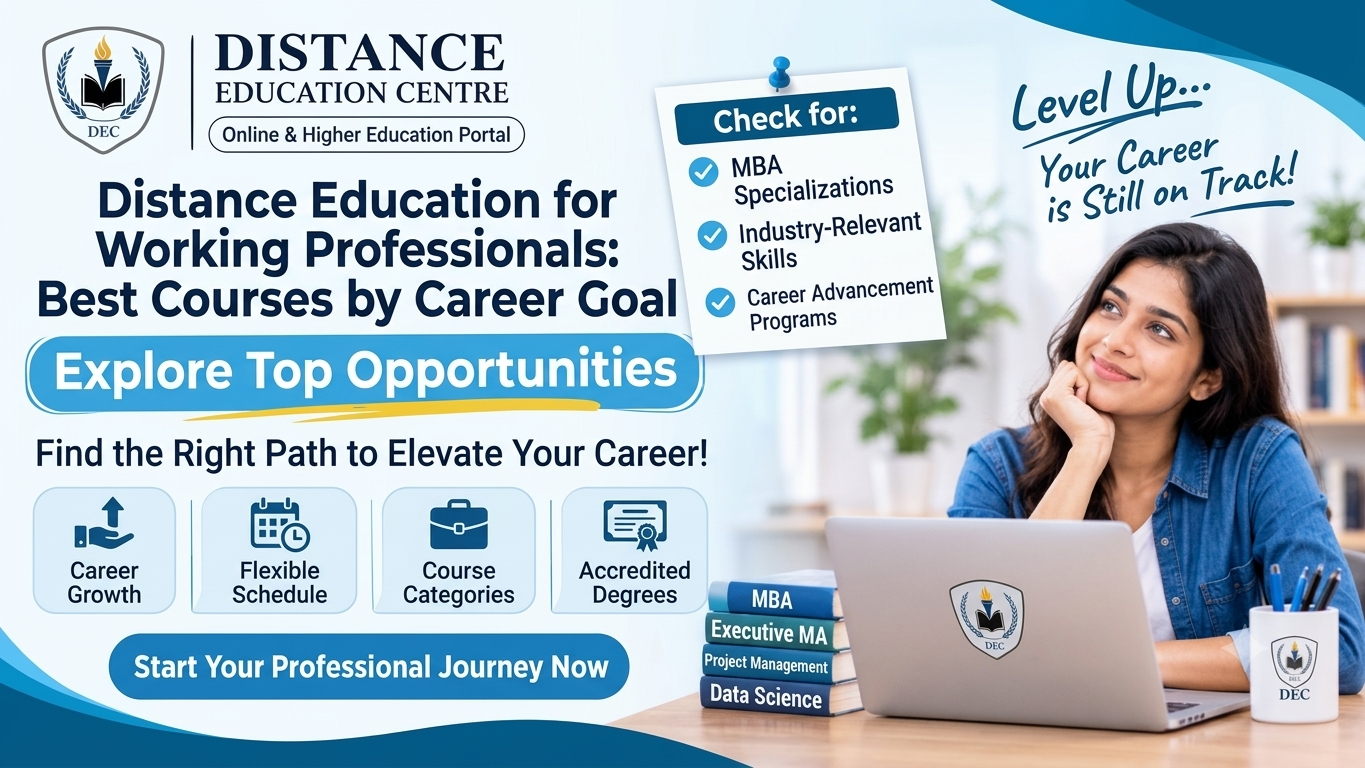
Managing a full-time job while studying is not always easy. Working professionals have deadlines, meetings, family responsibilities and many other things to take care of. Because of this, attending regular college classes may not be a practical option for everyone.
This is where distance education for working professionals becomes useful. It allows learners to continue their education without leaving their jobs or following a fixed daily classroom schedule. Students can study through printed material, online resources, recorded lectures and digital learning platforms, depending on the university and programme.
But one question often comes up: Which distance education course is best for career growth? The answer depends on what you want to achieve. Some professionals want a promotion, others want to switch careers, and many simply want to complete a degree after years of working.
Let’s explore the best distance education courses in India according to different career goals.
What Is Distance Education and Who Should Choose It?
Distance education is a learning method in which students and teachers do not need to be physically present in the same classroom for regular teaching. Study material and academic support are provided through different channels, allowing learners to study from their preferred location.
Working professionals can consider distance education if they want to:
- Complete a graduation or postgraduate degree while working.
- Become eligible for higher-level job positions.
- Develop knowledge in a new subject or industry.
- Prepare for a career change.
- Improve their qualifications without taking a long break from work.
There are two common learning formats: Open and Distance Learning (ODL) and online education. ODL may include self-learning material, assignments and scheduled examinations, while online programmes generally use digital platforms for learning and academic activities. The exact structure varies by university.
Best Distance Education Courses for Working Professionals by Career Goal
There is no single course that is best for everyone. A person working in sales may benefit from an MBA, while someone interested in software development may prefer a BCA or MCA. The following table can help you shortlist a programme.
| Career goal | Recommended course | Suitable for |
|---|---|---|
| Move into management | MBA | Team leaders, executives and managers |
| Build an IT career | BCA or MCA | IT support staff and technology aspirants |
| Improve finance knowledge | MCom or MBA Finance | Accountants and finance professionals |
| Enter marketing | MBA Marketing or relevant PG programme | Sales and marketing employees |
| Develop HR skills | MBA HR | HR executives and team coordinators |
| Start a business | MBA or BBA | Entrepreneurs and business owners |
| Work in education | MA or relevant education programme | Graduates interested in academic roles |
| Build a career in social development | MSW | NGO workers and social-sector professionals |
1. MBA: Best for Professionals Who Want Management Roles
An MBA is one of the most popular choices for working professionals. It helps learners understand business operations, leadership, finance, marketing, human resources and strategic decision-making.
If you are already working as an executive, supervisor or team coordinator, an MBA can help you prepare for responsibilities at a higher level. It is also a suitable option for professionals who want to move from a technical role into management.
Popular MBA specialisations include:
- Marketing Management
- Finance Management
- Human Resource Management
- Operations Management
- Business Analytics
- International Business
For example, a sales executive who wants to become a sales manager can consider an MBA in Marketing. Similarly, someone working in accounts may find an MBA in Finance more relevant.
Before applying, check the university’s eligibility rules, course duration, examination pattern and recognition status.
2. BCA and MCA: Best for IT and Technology Careers
Technology is an important part of almost every industry. Professionals interested in software, programming, database management or IT services can consider computer application programmes.
A Bachelor of Computer Applications (BCA) is generally suitable for students who have completed Class 12 and want to start learning computer applications. A Master of Computer Applications (MCA) is a postgraduate option for eligible graduates who want advanced knowledge of computing and software-related subjects.
These programmes may cover programming languages, database management, computer networks, software development and related areas.
However, a degree alone does not guarantee an IT job. Learners should also build practical skills through projects, internships and relevant certifications.
3. MCom and MBA Finance: Best for Finance Professionals
If you are working in banking support, accounting, taxation or financial operations, a commerce or finance-related postgraduate course may help strengthen your knowledge.
MCom is a suitable option for graduates interested in advanced commerce subjects. It generally covers accounting, business management, economics, taxation and financial concepts.
An MBA in Finance is more focused on business finance, financial planning, investment management and decision-making.
The choice depends on your career direction. MCom may suit someone interested in strengthening their academic and commerce background, whereas MBA Finance may be more appropriate for someone aiming for management responsibilities.
4. MBA in HR: Best for Human Resource Professionals
HR professionals handle recruitment, employee engagement, training, payroll coordination and workplace policies. If you are already working in an HR department, an MBA in Human Resource Management can help you understand these responsibilities at a deeper level.
The programme generally covers organisational behaviour, talent management, performance management, labour-related concepts and human resource planning.
It may be useful for HR executives who want to move into roles such as HR manager, talent acquisition manager or learning and development coordinator. Actual job eligibility depends on the employer’s requirements and your work experience.
5. MBA in Marketing: Best for Sales and Marketing Employees
Professionals working in sales, advertising, customer relations or digital marketing can consider an MBA in Marketing.
The course introduces learners to consumer behaviour, branding, market research, sales management and marketing strategies. It can be useful for employees who want to move into team leadership or marketing management.
If you are interested in digital marketing, you should also learn practical tools related to SEO, social media, analytics and online advertising. These skills can complement your academic qualification.
6. MA and MSW: Best for Education and Social Sector Careers
Not every working professional wants to enter business or technology. Some learners are interested in teaching-related fields, research, public services or social development.
An MA in a relevant subject can help graduates gain deeper academic knowledge. Depending on the subject and eligibility requirements, it may support careers in education, research, writing or related areas.
A Master of Social Work (MSW) may suit learners interested in community development, NGOs, social welfare and programme coordination.
Always check the current UGC-DEB programme list before selecting a course. Some healthcare and allied disciplines have restrictions for ODL and online delivery, including specified psychology specialisations from the August 2026 academic session onwards.
Which Course Is Best for Distance Education After 12th?
Students who have completed Class 12 can choose from several undergraduate distance education programmes. The right course depends on their interests, subjects studied and future career plans.
| Course | Main area of study | Possible career direction |
|---|---|---|
| BA | Humanities and social sciences | Content, administration and further studies |
| BCom | Accounting, commerce and business | Accounts, banking support and finance |
| BBA | Business and management | Sales, operations and business support |
| BCA | Computer applications | IT support and further technology studies |
| BLIS | Library and information science | Library and information services, subject to eligibility |
For example, a student interested in business can consider BBA, while someone who enjoys accounts and finance may prefer BCom. Students interested in computers can explore BCA, provided they meet the university’s eligibility conditions.
Do not select a course only because it is popular. Think about the type of job you want after graduation and whether the programme will help you move towards it.
UGC Approved Online Degree Courses in India: What Should You Check?
When searching for UGC approved online degree courses in India, students should understand that recognition is linked to the university, programme and academic session. A university being recognised does not automatically mean every course offered by it is approved in every mode.
The University Grants Commission (UGC) regulates higher education, while its Distance Education Bureau (DEB) publishes information about recognised and entitled institutions and programmes.
Before taking admission, check the following:
- Whether the university is recognised or entitled for the selected mode.
- Whether your exact programme appears in the list for the relevant academic session.
- Whether the course is available in ODL or online mode.
- Whether the university’s admission process and study arrangements are genuine.
- Whether the programme has any professional or regulatory restrictions.
UGC also advises students to check recognition for the specific session instead of assuming that approval from a previous year will continue automatically.
ODL Full Form in Company: Does It Mean the Same Thing?
The ODL full form in education is Open and Distance Learning. It refers to a method of providing education where learners can study without attending regular face-to-face classes.
However, when someone searches for ODL full form in company, the meaning may be different. Companies can use the same abbreviation for internal terms, departments or workplace processes. There is no single universal company-related expansion that applies to every organisation. It is best to check the company’s HR policy or internal glossary.
In an education context, ODL specifically refers to Open and Distance Learning.
Distance Education vs Online Education: Which Is Better for Working Professionals?
Both formats can help professionals study while continuing their jobs, but their learning methods may differ.
| Factor | Distance education (ODL) | Online education |
|---|---|---|
| Learning material | Printed or digital material | Mainly digital material |
| Classes | May have limited or scheduled academic support | May include live and recorded classes |
| Flexibility | Often suitable for self-paced study | Depends on class and assessment schedules |
| Interaction | May involve study centres and academic support | Usually through online platforms |
| Best suited for | Independent learners | Learners comfortable with digital learning |
Neither format is automatically better. Choose according to your learning style, internet access, work schedule and the programme’s structure.
How to Choose the Right Distance Education Course
Before applying, take some time to understand your career needs. If your aim is promotion, choose a programme that matches the qualifications expected for your target role. If you want to change industries, look for a course that gives you a foundation in the new field.
You should also compare the total fees, course duration, examination schedule, assignment requirements and student support facilities. Working professionals should pay special attention to examination dates because they may need to plan leave from work.
It is also sensible to check whether the university provides recorded lectures, online study material, a student portal and access to academic guidance.
Conclusion
Distance education for working professionals is a practical way to continue learning without putting your career on hold. An MBA can support management ambitions, BCA or MCA can help build technology knowledge, and MCom or MA programmes can strengthen subject expertise.
The best course is not necessarily the most popular or expensive one. It is the programme that matches your qualifications, career plans and available study time. Most importantly, verify the university and programme recognition for your admission session before paying the fees. A little research now can help you avoid problems later.
Frequently Asked Questions (FAQs)
1. Which distance education course is best for working professionals?
An MBA is a popular choice for professionals interested in management. BCA, MCA, MCom, MA and MSW can also be suitable, depending on the learner’s career goal and previous qualification.
2. Can I complete a distance education degree while doing a full-time job?
Yes. Distance education is designed to offer flexibility to learners who cannot attend regular classes. However, you still need to complete assignments, examinations and other academic requirements within the university’s schedule.
3. Which course is best for distance education after 12th?
BA, BCom, BBA and BCA are common undergraduate options. The right choice depends on your interests, Class 12 subjects and future career plans.
4. Is distance education valid for private-sector jobs?
A degree from a recognised university and an appropriately recognised programme can be considered for employment, subject to the employer’s eligibility requirements. Always verify the programme’s recognition for your admission session.
5. Are UGC approved online degree courses in India valid?
UGC-recognised or entitled institutions can offer approved online programmes under the applicable regulations. Students should verify the exact university, programme and academic session on the UGC-DEB website.
6. What is the ODL full form in education?
ODL stands for Open and Distance Learning. It is a mode of education that allows students to learn without attending regular classroom sessions.
7. What is the ODL full form in company?
There is no universal company-related expansion of ODL. Its meaning depends on the organisation and the context in which the abbreviation is used. In education, it means Open and Distance Learning.
8. Is an online MBA better than a distance MBA?
Both can be useful. An online MBA may offer more digital interaction and live sessions, while an ODL MBA may provide greater flexibility for independent study. Compare the university, recognition, curriculum and learning support before deciding.
9. Can I pursue two distance education courses at the same time?
UGC regulations allow students to pursue two academic programmes simultaneously, subject to the applicable conditions and guidelines. Check the current rules and the admission requirements of both institutions before enrolling.
10. How do I check whether a distance education university is UGC-approved?
Visit the official UGC-DEB website and check the year-wise recognition or entitlement list. Confirm that the exact programme and mode are covered for your intended admission session.