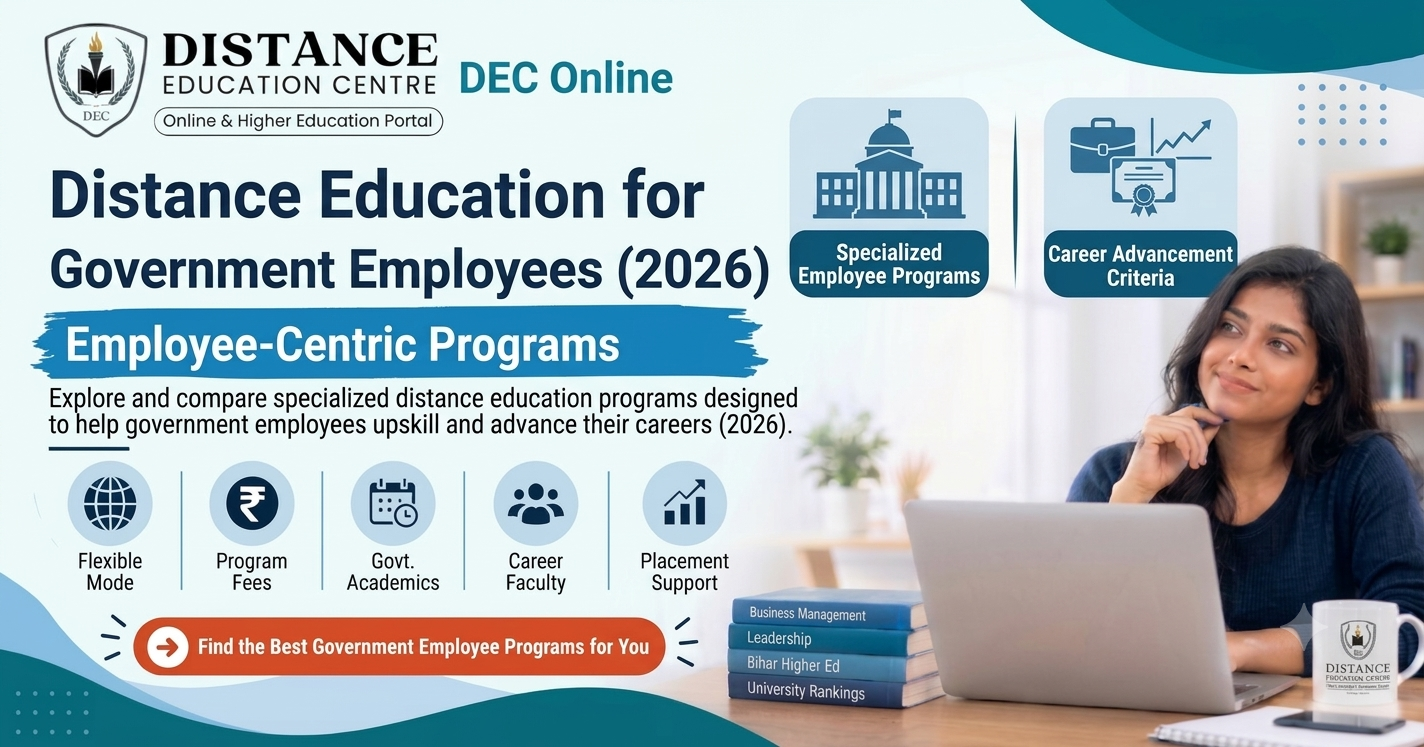
Government employees often want to continue their education while managing a full-time job. Whether someone works in a central government department, a state government office, a public sector undertaking (PSU), or a local government body, finding time for regular college classes can be difficult. This is where distance education becomes a practical option.
Distance education allows government employees to pursue a degree or diploma while continuing their job, subject to the rules of their department and the requirements of the chosen programme. Employees can study subjects such as management, commerce, arts, computer applications, public administration, and other disciplines without attending a traditional college every day.
In 2026, several Indian universities offer recognised Open and Distance Learning (ODL) programmes. However, before enrolling, employees should check university recognition, programme approval, departmental permission requirements, and the eligibility rules for their intended promotion or future job.
This guide explains distance education for government employees in India, including degree validity, suitable courses, UGC-approved universities, the role of the Distance Education Bureau, and important precautions to take before admission.
Is Distance Education Valid for Government Jobs in India?
Yes, a distance education degree can be valid for government jobs in India if it meets the applicable recognition requirements and the recruitment notification accepts that qualification. The university, programme, mode of study, admission period, and eligibility conditions all matter.
The University Grants Commission (UGC) regulates higher education in India, while its Distance Education Bureau (DEB) oversees the recognition framework for Open and Distance Learning programmes. Students should verify that the university and the specific programme were recognised or entitled for the relevant admission session.
For example, an employee pursuing a recognised distance BA, BCom, MA, MCom, or MBA may be able to use that qualification for further studies or eligible recruitment opportunities. However, some jobs require a specific subject, professional qualification, minimum percentage, or other conditions.
A degree being offered online or through distance learning does not automatically make it acceptable for every government post.
Before taking admission, check these three things:
- Whether the university and programme have the required UGC-DEB recognition for your admission session.
- Whether the recruitment or promotion rules accept the qualification and mode of study.
- Whether your department requires prior permission or intimation for further education.
Distance Education Rules for Government Employees in 2026
Government employees should understand that academic recognition and departmental permission are two different matters. A university may offer a recognised degree, but an employee may still need to follow service rules before enrolling.
The applicable procedure depends on whether the employee works for the central government, a state government, a PSU, a bank, a local authority, or another organisation.
| Important factor | What government employees should check |
|---|---|
| University recognition | Verify the university through official UGC information. |
| Programme recognition | Check the exact course and admission session in the UGC-DEB records. |
| Departmental permission | Review service rules and ask the appropriate authority if permission or prior intimation is required. |
| Working hours | Ensure that classes, practicals, examinations, or contact sessions do not conflict with official duties. |
| Promotion eligibility | Confirm that the qualification is accepted under the relevant service or promotion rules. |
| Professional courses | Check any additional regulatory or professional requirements. |
For central government employees, the relevant service rules and departmental instructions should be consulted. State government employees must also check the rules issued by their state or employing authority.
Do not assume that one permission rule applies to every government employee. Getting written clarification from the department can prevent problems later.
UGC Approved Distance Education Universities List: Where Should Employees Study?
There is no single permanent list that applies to every course and admission year. The UGC-DEB database provides programme-wise information about recognised universities and the programmes they may offer through distance or online learning.
Government employees can start their search with the following universities and institutions. However, the table is a shortlist for research, not a guarantee that every listed programme is recognised for the 2026 session. Check the exact course and mode before enrolling.
| University or institution | Courses to explore |
|---|---|
| Indira Gandhi National Open University (IGNOU) | BA, BCom, MA, MCom, MBA and other eligible programmes |
| University of Delhi – School of Open Learning | Undergraduate and postgraduate programmes offered through its open-learning system |
| Dr. B.R. Ambedkar Open University | Arts, commerce, social sciences and other available programmes |
| Tamil Nadu Open University | Undergraduate, postgraduate, diploma and certificate programmes |
| Netaji Subhas Open University | Arts, commerce and other available open-learning programmes |
| Uttarakhand Open University | Management, humanities, commerce and other available programmes |
To verify current recognition, use the official UGC-DEB recognised programmes database. You can filter the available information by year, session, mode, university, and programme. The UGC also advises students to check recognition for the specific admission session rather than relying on an institution’s previous approval.
How to Check Whether a Distance Degree Is Recognised
The verification process is simple, but you should not skip it.
- Open the official UGC-DEB website.
- Find the recognised ODL or online programmes section.
- Select the relevant academic year and admission session.
- Search for the university and the exact programme name.
- Confirm the mode of study and recognition details before paying the admission fee.
The Distance Education Bureau also provides information about prohibited programmes. Some subjects, including engineering, medicine, nursing, pharmacy, law and certain other regulated or practical disciplines, cannot generally be offered through ODL or online mode under the applicable UGC framework. Always check the latest rules for your intended course.
Best Distance Education Courses for Government Employees
The right course depends on your current qualification, department, career plans, and available study time. Some employees want to complete their graduation, while others pursue a postgraduate degree to support career development or meet promotion requirements.
| Course | Suitable for | Possible benefit |
|---|---|---|
| BA | Employees who need an undergraduate degree or want to study humanities | Builds a foundation in subjects such as history, political science or sociology |
| BCom | Employees interested in commerce and accounts | Develops knowledge of accounting and business |
| MA Political Science or Public Administration | Employees interested in governance and administration | Supports academic understanding of public institutions |
| MCom | Commerce graduates | Strengthens knowledge of finance and commerce |
| MBA | Eligible graduates seeking management knowledge | Develops management and leadership skills |
| MCA | Eligible graduates meeting the programme’s entry criteria | Supports IT-related learning where the programme is recognised |
| Diploma or certificate courses | Employees seeking focused skills | Offers specialised learning in a shorter format |
These are course categories to consider, not a guarantee of promotion or eligibility for a particular government position. For example, an MBA may be useful for management knowledge, but it will not automatically qualify an employee for a promotion that requires a specific examination or service experience.
Before enrolling, compare the course syllabus with the qualification requirements mentioned in the relevant recruitment rules or service regulations.
Distance Education for Central and State Government Employees
Central and state government employees can both explore distance learning, but the rules governing their service may be different.
For central government employees, the relevant department’s conduct rules, establishment instructions, and other applicable service provisions should be reviewed. State employees should refer to their state service rules and departmental circulars. Employees working in public sector banks, PSUs, defence services, and other organisations may have separate policies.
An employee should clarify whether the course requires attendance during office hours, practical training, a study leave arrangement, or permission from the competent authority. Even when the programme is delivered online, examinations or mandatory activities might require travel or time away from work.
A practical approach is to obtain written confirmation from the administration or HR section before admission, especially if the degree is intended for promotion, a departmental examination, or a change in job role.
Benefits of Distance Education for Government Employees
The biggest advantage is flexibility. Employees do not usually need to attend a physical college every day, which makes it easier to balance work, family and studies. Learning materials may be available digitally or through printed study material, depending on the programme.
Another benefit is the range of subjects available. An employee can pursue a qualification related to their current department or explore another field for future career opportunities. The comparatively flexible schedule can also make it easier to revise lessons before examinations.
However, distance education still requires regular effort. Assignments, examinations, practical components, and project work can take time. Employees should select a course they can realistically complete without affecting their official responsibilities.
Documents and Admission Process
The admission procedure varies by university, but most applications require basic personal and academic information.
Applicants should generally prepare their previous qualification marksheets, certificates, identity documents, photograph, signature, and any additional documents requested by the university. Some programmes may require entrance-test results or proof of professional eligibility.
After choosing a course, complete the application on the university’s official website, upload the required documents, pay the prescribed fee, and save the application receipt. Check the admission status and retain the recognition details for your records.
For 2026 admissions, pay special attention to the academic session and the programme’s recognition period. A university being recognised for one course or session does not automatically mean all its courses are approved for every subsequent year.
Common Mistakes to Avoid Before Taking Admission
One of the biggest mistakes is selecting a university only because its fees are low. Affordability matters, but recognition, programme quality, examination arrangements, and eligibility for your intended purpose are equally important.
Another mistake is assuming that every distance degree is accepted for every government promotion. Recruitment bodies and departments may specify particular qualifications, subjects, marks, or other conditions. A recognised degree does not override those requirements.
Employees should also avoid enrolling through unauthorised admission agents or franchises. Complete the process through the university’s official website and keep copies of receipts, enrolment details, and relevant recognition records.
Frequently Asked Questions (FAQs)
1. Is a distance degree valid for government jobs in India?
Yes, a degree awarded through a recognised ODL programme can be accepted for government jobs, provided it meets the recruitment notification’s eligibility conditions and applicable regulations.
2. Can a government employee study through distance education while working?
Generally, employees can explore distance learning while employed, subject to their department’s applicable service rules. They should check whether prior permission or intimation is required.
3. Which distance education university is best for government employees?
There is no single best university for every employee. IGNOU, state open universities, and other recognised institutions can be considered after checking programme availability, recognition, fees, and departmental requirements.
4. What is the Distance Education Bureau (DEB)?
The Distance Education Bureau is part of the UGC and administers the recognition framework for eligible higher education institutions offering Open and Distance Learning programmes. Students can use its website to verify recognised programmes.
5. How can I find the UGC approved distance education universities list?
Visit the official UGC-DEB programme database. Check the university, course, study mode, academic year, and session before taking admission.
6. Is an IGNOU degree valid for central government jobs?
An IGNOU degree may be accepted when the programme and admission session meet the applicable recognition requirements and the recruitment rules accept the qualification. Always verify the conditions for the specific post.
7. Can distance education help government employees get promotions?
It may help employees meet an educational qualification requirement, but promotion depends on the applicable service rules, vacancies, seniority, performance, examinations, and other criteria.
8. Do government employees need permission for distance education?
The requirement depends on the employee’s department and applicable service rules. Check with the competent authority before enrolling, particularly if attendance or examinations could affect official duties.
9. Which distance courses are useful for government employees?
BA, BCom, MA, MCom, MBA, MCA, and selected diploma or certificate courses may be worth considering, depending on eligibility and career goals. Their suitability for promotion or recruitment must be verified separately.
10. Can I pursue an online degree instead of a distance degree?
Yes, if the institution offers the relevant programme in an appropriately recognised online mode and you meet its eligibility requirements. Online learning and ODL have different delivery arrangements, so verify the mode listed by UGC-DEB.
Conclusion
Distance education for government employees in 2026 offers a practical way to continue higher education without leaving a job. Employees can explore undergraduate degrees, postgraduate programmes, diplomas, and certificates according to their qualifications and career plans.
The most important step is to verify the university and programme through the UGC-DEB official database. Also, confirm departmental permission requirements and the qualification rules for any intended promotion or government recruitment.
A recognised distance degree can open further academic and career opportunities, but it should be chosen carefully. Compare the course, fees, study schedule, and eligibility requirements before applying so that your education supports your goals without creating difficulties in your service.